Planning your trip and wondering about Vietnam weather in January? You’re not alone — and you’ve come to the right place.
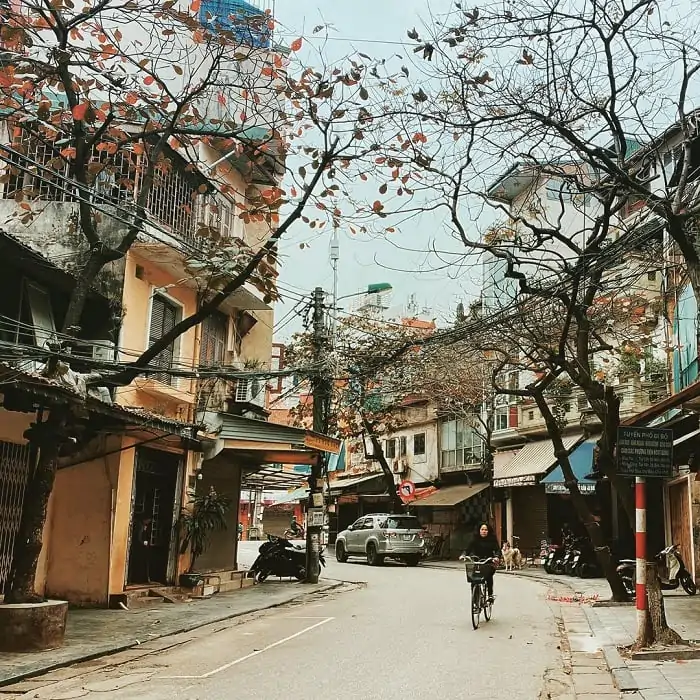
Every January, I watch the same thing happen at Noi Bai Airport. A family steps off the plane from Sydney in shorts and flip-flops, expecting the tropical Vietnam they saw in every travel brochure. They walk through the sliding doors into a wall of cold, damp Hanoi air — 16°C, foggy, the kind of chill that gets into your bones. The father looks at me and says: “Nobody told us it would be like this.”
That moment is why I wrote this guide.
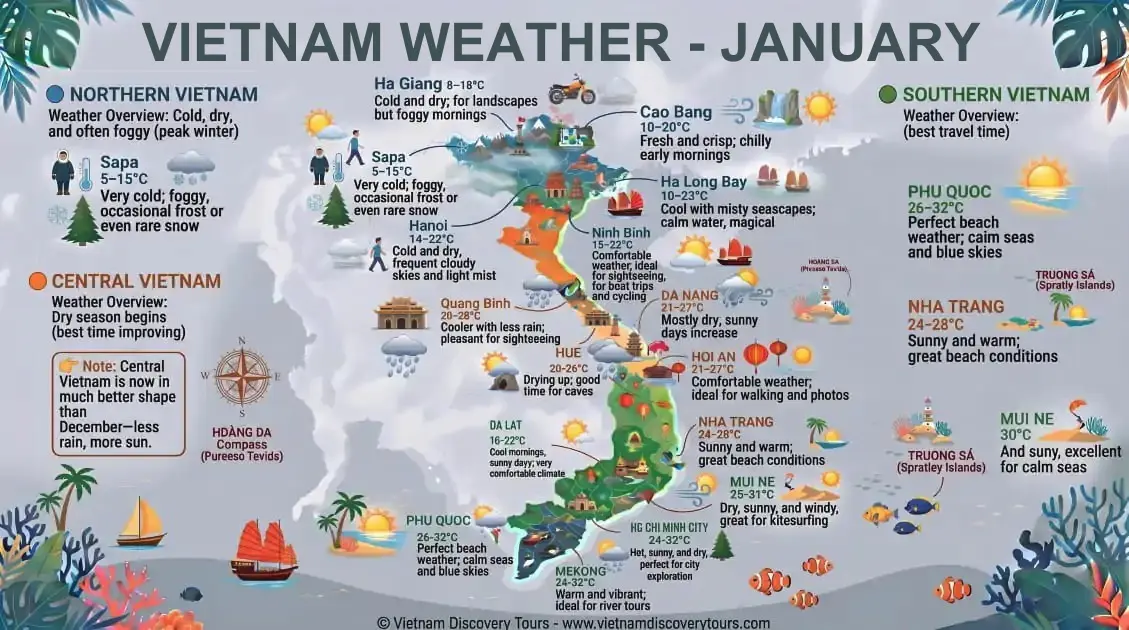
Vietnam weather in January is not one weather. It is three completely different climates happening at the same time, in the same country, separated by a few hours on a train. After eight years guiding more than 500 groups across Vietnam in January — from frozen Sapa ridgelines to the perfect blue water of Phu Quoc — I can tell you exactly what to expect, region by region, week by week.
The single most common mistake I see is people planning based on generic articles written by someone who has never stood in Hanoi fog at 7 AM, or watched the mist roll across Halong Bay karsts in winter light. Those articles give you averages. This guide gives you the truth.
Every temperature range, every packing tip, every warning here comes from standing in that weather with real guests — and watching what happens when they’re prepared, and when they’re not.
Peak dry season
Calm seas, blue skies
Comfortable, fewer crowds
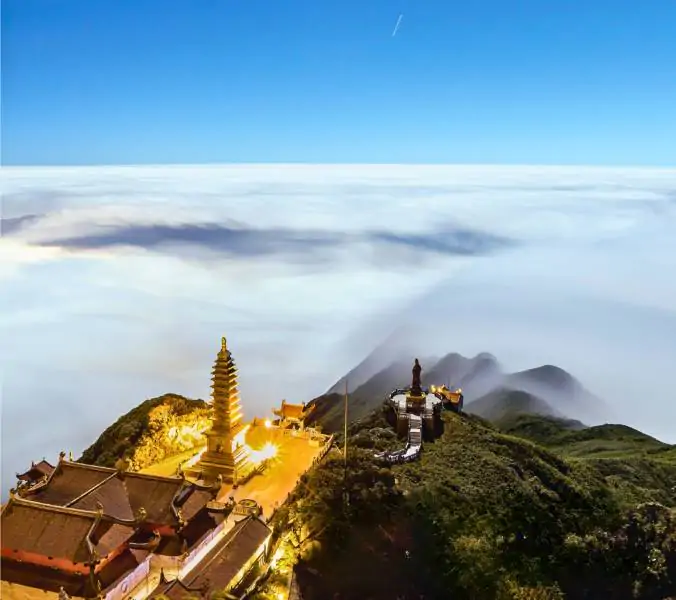
Magical winter mist
Book everything early
Frost, occasional snow
Northern Vietnam Weather in January — Cold, Foggy & Underrated
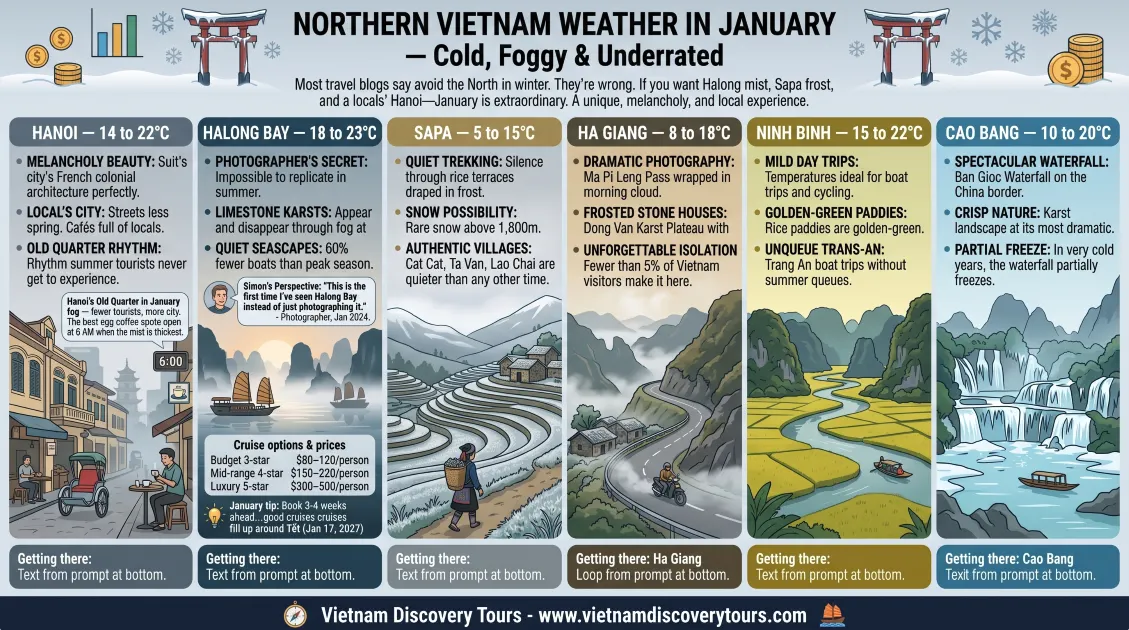
The honest truth about Northern Vietnam in January: it is cold, grey, and often misty. And it is one of the most beautiful things I have ever seen.
Most travel blogs tell you to avoid the north in winter. They are wrong — or rather, they are thinking about the wrong kind of traveler. If you want beaches and sunshine, go south. But if you want Halong Bay emerging from winter mist at 7 AM with no other boats in sight, if you want Sapa rice terraces draped in frost, if you want a Hanoi that belongs to locals instead of tourists — January in the north is extraordinary.
I had a photographer from Berlin on a January tour of Halong Bay last year. She had been three times before — always in summer. This time, the morning mist rolled across the karsts at sunrise and she didn’t take a single photo for ten minutes. Just stood at the bow of the boat. Afterwards she told me: “This is the first time I’ve seen Halong Bay instead of just photographing it.” That’s what winter does to this place.
Hanoi — 14 to 22°C
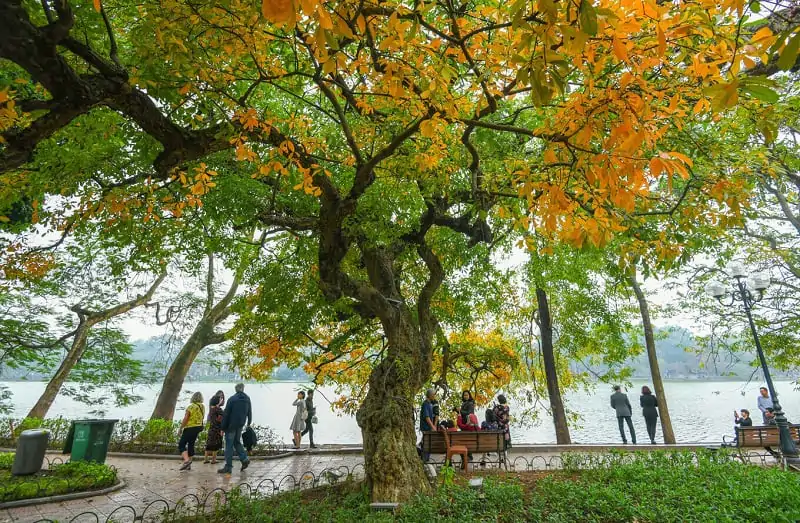
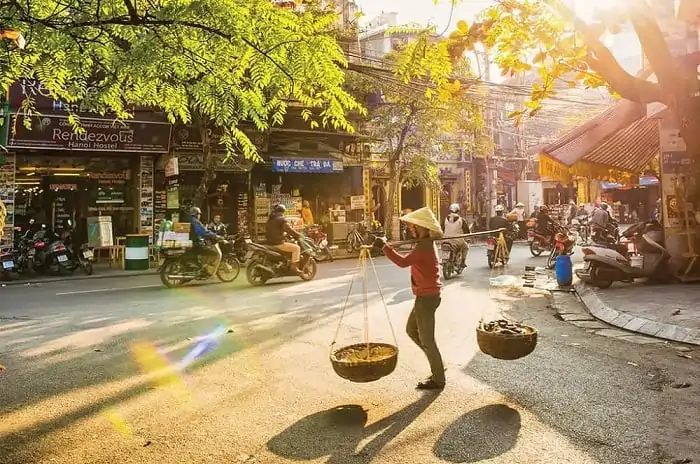
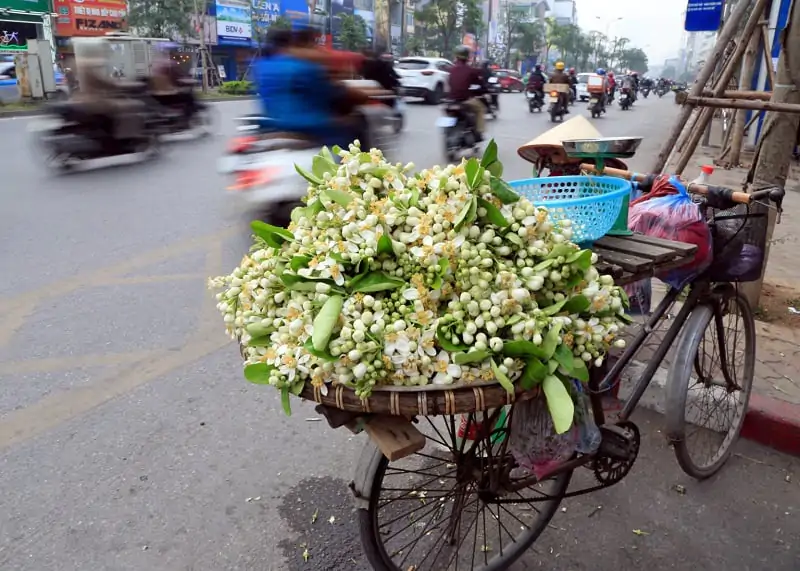
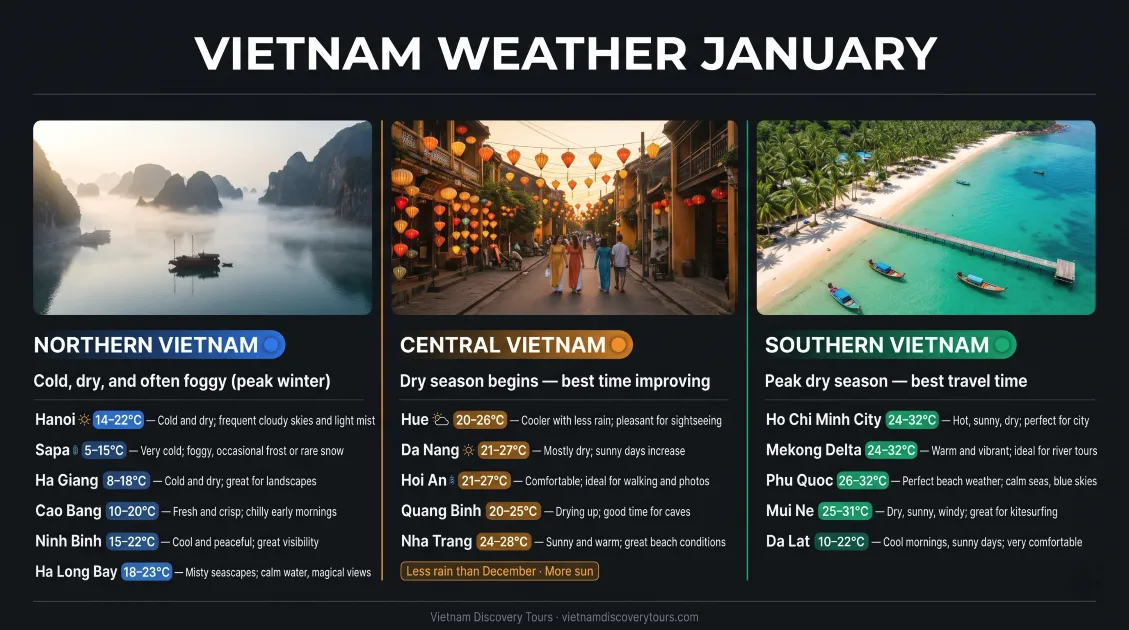
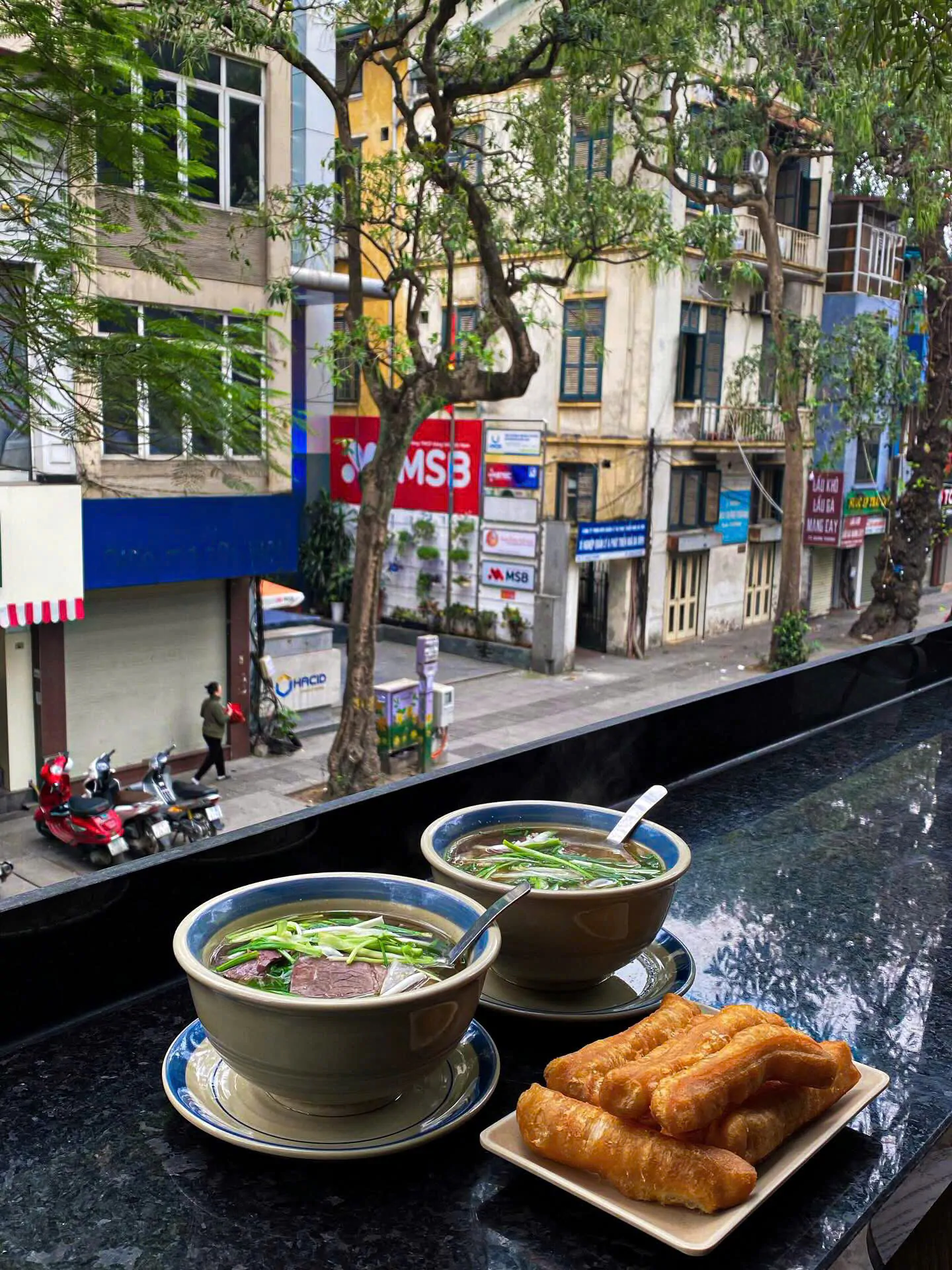
Cold and dry with frequent cloudy skies and light morning mist. Hanoi in January has a melancholy beauty that suits the city’s French colonial architecture perfectly. The streets are less crowded than spring, the cafés are full of locals nursing hot cà phê trứng (egg coffee), and the Old Quarter has a rhythm that summer tourists never get to experience.
Getting there: Noi Bai International Airport (HAN) — 45 minutes from Old Quarter by taxi (250,000–350,000 VND) or Grab (180,000–250,000 VND). Airport bus 86: 35,000 VND, 60 minutes.
Halong Bay — 18 to 23°C
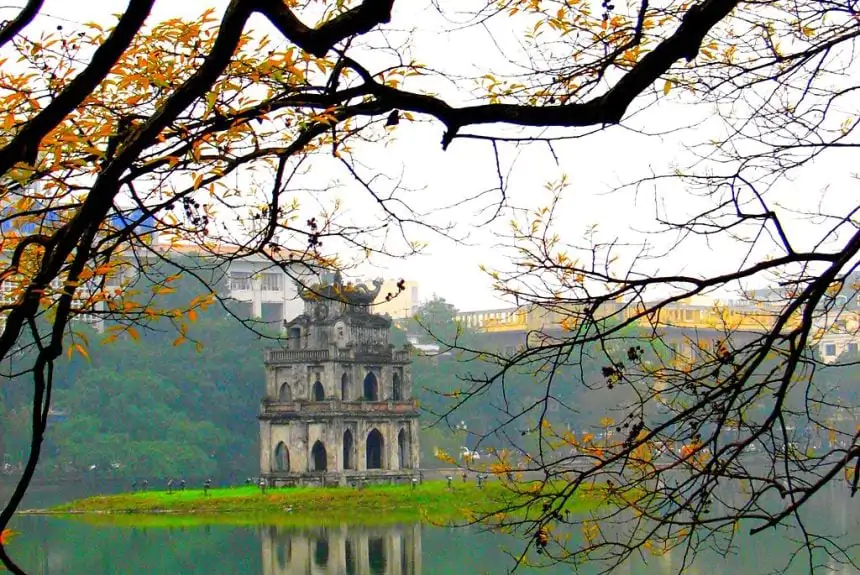
Cool with misty seascapes and calm water. This is the secret that photographers know: January mist in Halong Bay creates conditions that are impossible to replicate in summer. Limestone karsts appear and disappear through fog at sunrise. The water is perfectly calm. And there are 60% fewer boats than peak season.
Getting there from Hanoi: Cruise companies run shuttle buses from Hanoi Old Quarter — 3.5 hours, included in cruise price. Private car: 2.5 hours, 1,200,000–1,500,000 VND. Distance: 170 km via Highway 18.
Sapa — 5 to 15°C
Very cold with fog, occasional frost and rare snow above 1,800m. Sapa in January is not for everyone. But for those who want to trek through rice terraces in silence, with frost on the grass and no selfie sticks in sight, it is extraordinary. The hill tribe villages — Cat Cat, Ta Van, Lao Chai — are quieter and more authentic than any other time of year.
Getting there from Hanoi: Overnight train (SP1/SP3): departs 21:35–22:00, arrives Lao Cai 06:00–06:30. Ticket: 300,000–700,000 VND (soft seat to private cabin). Lao Cai to Sapa: 30 minutes by bus (50,000 VND) or taxi (150,000 VND). Distance Hanoi–Sapa: 315 km.
Ha Giang — 8 to 18°C
Cold and dry with foggy mornings — great for dramatic landscape photography. The Ha Giang Loop in January rewards the brave. Ma Pi Leng Pass wrapped in morning cloud, Dong Van Karst Plateau with frost on the stone houses, Lung Cu Flag Tower standing alone in pale winter light. Fewer than 5% of Vietnam visitors make it here in January. That is the entire point.
Getting there from Hanoi: Sleeper bus from My Dinh station: 7–8 hours, 300,000–350,000 VND. Private car: 6 hours, 2,500,000–3,000,000 VND. Distance: 300 km.
Ninh Binh — 15 to 22°C
Comfortable weather, ideal for boat trips and cycling. Ninh Binh is arguably the best northern destination in January. Temperatures are mild enough for full-day activities, the rice paddies are golden-green, and Trang An’s UNESCO boat trips run without the summer queues.
Getting there from Hanoi: Train from Hanoi station: 2 hours, from 65,000 VND. Limousine bus from Giap Bat: 2.5 hours, 120,000–150,000 VND. Distance: 95 km. Google Maps ↗
Cao Bang — 10 to 20°C
Fresh and crisp with chilly early mornings. Ban Gioc Waterfall on the China border is one of Vietnam’s most spectacular sights — and in January, the surrounding karst landscape is at its most dramatic. Almost no tourists. The waterfall partially freezes in very cold years, creating something you will not see anywhere else in Southeast Asia.
Getting there from Hanoi: Sleeper bus: 8–9 hours, 250,000–300,000 VND. Best done as part of a 3-day Northeast Vietnam loop. Distance: 272 km.
Central Vietnam Weather in January — The Turning Point
January is the month Central Vietnam decides to become itself again after months of rain. The transformation is not instant — it happens week by week through January, like the region slowly drying out and warming up after a long illness.
The first week of January in Da Nang and Hoi An can still bring rain from the previous season’s tail end. The last week is often perfect. If you can choose, arrive in the second half of January — statistically the best odds for dry weather. I always tell my guests: Central Vietnam in late January is like early spring in Europe. Not hot yet, not cold, not rainy. Just right.
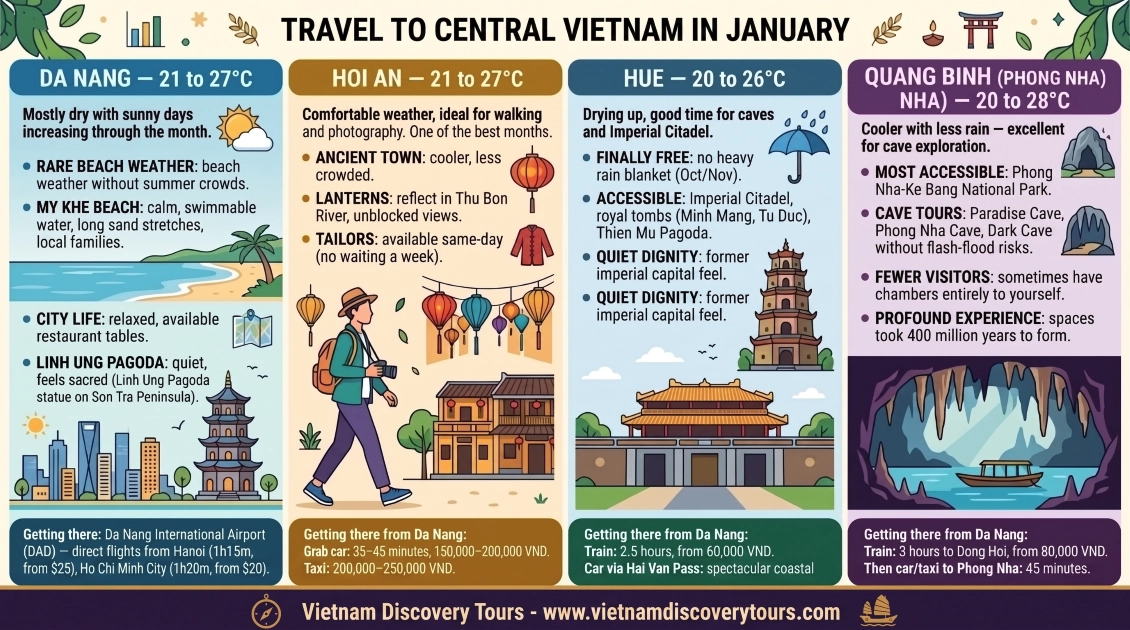
Da Nang — 21 to 27°C
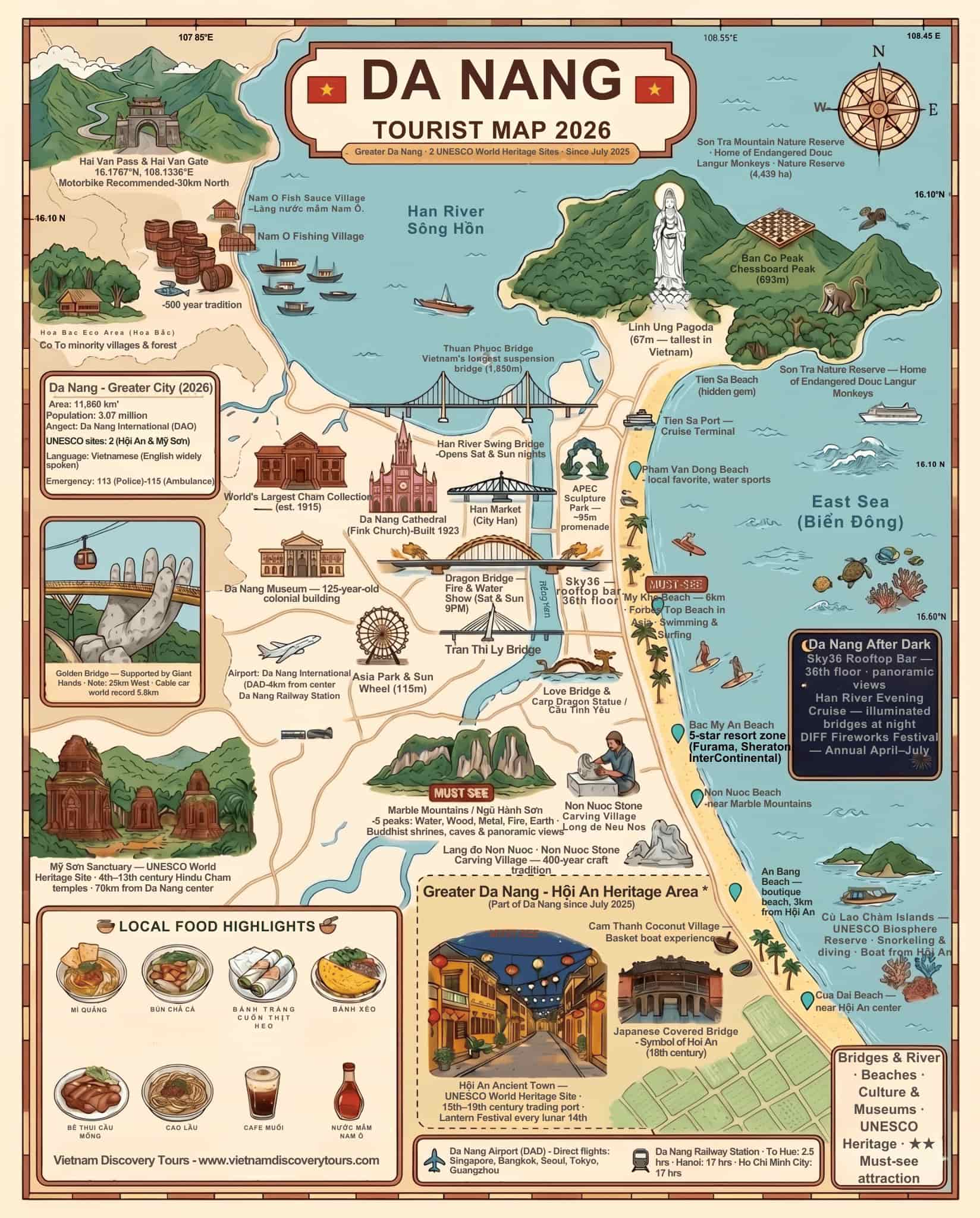
Mostly dry with sunny days increasing through the month. Da Nang in January offers something rare: beach weather without the summer crowds. My Khe Beach in January has calm, swimmable water and long stretches of sand with local families rather than tourist coaches. The city itself is relaxed, restaurants have tables available without reservations, and Linh Ung Pagoda on Son Tra Peninsula is quiet enough to feel sacred rather than like a theme park.
Getting there: Da Nang International Airport (DAD) — direct flights from Hanoi (1h15m, from $25), Ho Chi Minh City (1h20m, from $20). City centre: 3 km from airport, Grab 30,000–50,000 VND. Google Maps ↗
Hoi An — 21 to 27°C
Comfortable weather, ideal for walking and photography. January is one of the best months to visit Hoi An. The Ancient Town — now officially part of Greater Da Nang since the July 2025 merger — is cooler and less crowded than summer, the lanterns reflect in the Thu Bon River without tour boats blocking the view, and tailors can actually see you same-day instead of making you wait a week.
Getting there from Da Nang: Grab car: 35–45 minutes, 150,000–200,000 VND. Taxi: 200,000–250,000 VND. Local bus 1: 20,000 VND, 60 minutes. Distance: 30 km south of Da Nang. Google Maps ↗
Hue — 20 to 26°C
Drying up, good time for caves and Imperial Citadel. Hue in January is finally free from the heavy rain that blanketed it through October and November. The Imperial Citadel, royal tombs of Minh Mang and Tu Duc, and Thien Mu Pagoda are all accessible without getting drenched. The city has a quiet dignity in January that feels appropriate for a former imperial capital.
Getting there from Da Nang: Train: 2.5 hours, from 60,000 VND. Car via Hai Van Pass: 2.5 hours, spectacular coastal scenery, 800,000–1,000,000 VND. Distance: 100 km north of Da Nang.
Quang Binh (Phong Nha) — 20 to 28°C
Cooler with less rain — excellent for cave exploration. Phong Nha-Ke Bang National Park in January is at its most accessible. Paradise Cave, Phong Nha Cave, and the Dark Cave adventure tour all run without the summer flash-flood risks. Fewer visitors means you can sometimes have the cave chambers entirely to yourself — a profound experience in spaces that took 400 million years to form.
Getting there from Da Nang: Train: 3 hours to Dong Hoi, from 80,000 VND. Then car/taxi to Phong Nha: 45 minutes, 300,000–400,000 VND. Distance: 200 km north of Da Nang.
Southern Vietnam Weather in January — Peak Season, No Apology
The south in January is exactly what travel brochures promise Vietnam will be: hot, sunny, impossibly blue water. January is the single best month to visit Phu Quoc, Mui Ne and Ho Chi Minh City. No caveats, no “but watch out for…” — just perfect tropical weather.
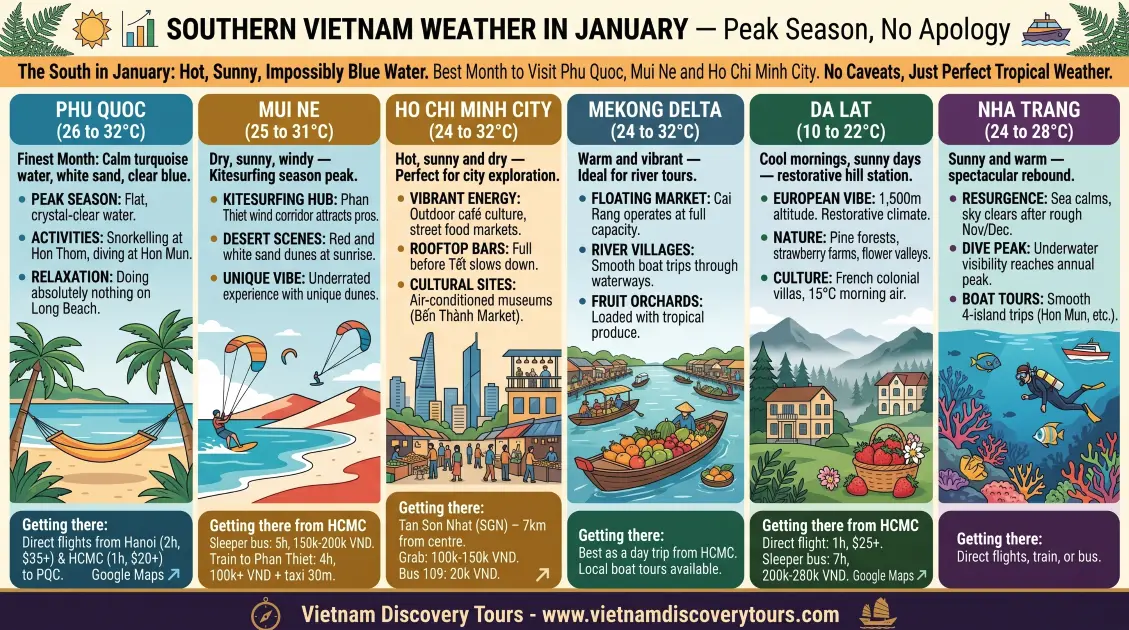
Phu Quoc — 26 to 32°C
Perfect beach weather with calm seas and blue skies. January is Phu Quoc’s finest month. The northeast monsoon that hits the mainland has no power over this island on Vietnam’s western coast — January brings flat, crystal-clear water ideal for snorkelling at Hon Thom, diving at Hon Mun, and doing absolutely nothing on Long Beach for days at a time.
Getting there: Direct flights from Hanoi (2h, from $35) and Ho Chi Minh City (1h, from $20) to Phu Quoc International Airport (PQC). Google Maps ↗
Mui Ne — 25 to 31°C
Dry, sunny and windy — kitesurfing season peak. If you kitesurf or windsurf, January in Mui Ne is a pilgrimage. The Phan Thiet wind corridor creates conditions that attract professionals from across Asia. Even if you don’t kite, the red and white sand dunes at sunrise with nobody else around are one of Vietnam’s most underrated experiences.
Getting there from Ho Chi Minh City: Sleeper bus: 5 hours, 150,000–200,000 VND. Train to Phan Thiet: 4 hours, from 100,000 VND + taxi 30 minutes. Distance: 200 km northeast of HCMC.
Ho Chi Minh City — 24 to 32°C
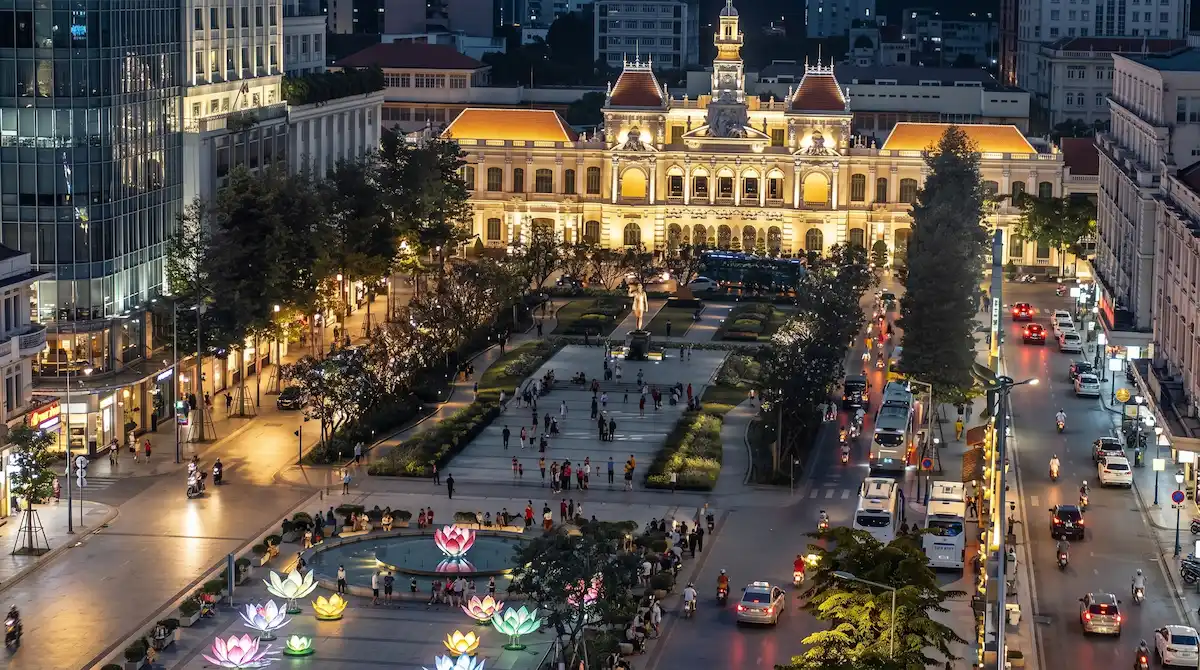
Hot, sunny and dry — perfect for city exploration. January is one of HCMC’s best months: dry season in full force, outdoor café culture in bloom, and the city operating at full energy before it slows down for Tết preparations in mid-January. The rooftop bars are full, the street food markets are vibrant, and the museums are air-conditioned sanctuaries from the midday heat.
Getting there: Tan Son Nhat Airport (SGN) — 7 km from city centre. Grab: 100,000–150,000 VND. Bus 109: 20,000 VND. Google Maps ↗
Mekong Delta — 24 to 32°C
Warm and vibrant with ideal conditions for river tours. The Mekong Delta in January is lush, active and accessible. Cai Rang floating market operates at full capacity, boat trips through the waterway villages are smooth, and the fruit orchards in Vinh Long and Ben Tre are loaded with tropical produce. The best day trip from Ho Chi Minh City, hands down.
Da Lat — 10 to 22°C
Cool mornings, sunny days and a very comfortable climate. Da Lat in January is a different kind of Vietnamese experience — a hill station at 1,500m altitude that feels more like a European spa town than Southeast Asia. Strawberry farms, flower valleys, pine forests and French colonial villas in 15°C morning air. For city-weary travellers, it is restorative in a way the beach never is.
Getting there from Ho Chi Minh City: Direct flight: 1 hour, from $25. Sleeper bus: 7 hours, 200,000–280,000 VND. Distance: 308 km. Google Maps ↗
Nha Trang — 24 to 28°C
Sunny and warm with great beach conditions. After a rough November and December, Nha Trang rebounds spectacularly in January. The sea calms, the sky clears, and the 4-island boat tours (Hon Mun, Hon Mot, Hon Tam, Hon Mieu) run smoothly. The underwater visibility for diving reaches its annual peak.
Where to Go in Vietnam in January — By Travel Style
What to Pack for Vietnam in January — By Region
Thermal base layers for Sapa
Waterproof outer shell
Warm hat and gloves (Sapa)
Sturdy walking shoes
Scarf — multipurpose
Layers — mornings are cool
Compact umbrella (just in case)
Comfortable walking shoes
Sunscreen SPF 30+
Light cotton shirts
Swimwear (multiple sets)
Sunscreen SPF 50+
Sunglasses and hat
Light sandals + walking shoes
Insect repellent (Mekong)
The single most common mistake is packing for one climate when you’re visiting three. If your January trip goes Hanoi → Da Nang → Phu Quoc, you need a warm jacket for day 1-2 and swimwear for day 7-10. Pack light and buy a cheap fleece in Hanoi’s Old Quarter (Hang Gai Street) for 150,000–250,000 VND — it’s not worth hauling a heavy jacket across tropical Vietnam for one cold stop.
Tết 2025 in January — What Every Visitor Must Know
Tết Nguyên Đán — Vietnamese Lunar New Year — falls on January 17, 2025. This is the single most important piece of travel information for anyone visiting Vietnam in January 2025.
- Jan 14–17: Pre-Tết rush — airports and trains at maximum capacity. Book tickets months in advance.
- Jan 17–22: Many restaurants, shops and local businesses closed. Tourist sites often open but with skeleton staff.
- Grab/taxi: Prices surge 2–3x during Tết days. Many drivers go home to their provinces.
- Hotels: Book before October 2026 for Tết week — rooms in Hoi An and Phu Quoc sell out completely.
- The upside: Hoi An lantern festival on Jan 17, fireworks in Hanoi and HCMC at midnight Jan 16–17, flower markets throughout January are spectacular.
Arrive before January 12 or after January 22. If you must be in Vietnam during Tết week, base yourself in Hoi An — the lantern festival on Tết Eve is one of the most beautiful things I have ever witnessed in eight years of guiding. But book your accommodation by August 2026 or it will be gone.
7 Things Only Local Guides Know About Vietnam in January
The Honest Answer
If someone asks me whether January is a good time to visit Vietnam, I say: it depends entirely on which Vietnam you mean.
If you mean Phu Quoc, Mui Ne, Da Nang, Hoi An, Ho Chi Minh City — yes, January is excellent. Some of these places are at their absolute best.
If you mean Hanoi, Halong Bay, Sapa, Ha Giang — yes, but pack warm and understand what you are getting. Not beaches. Not sunshine. Something rarer: the country stripped back to its bones, beautiful in a way that summer visitors never see.
In eight years of guiding January groups, I have never had a guest say it was the wrong time to come. But I have had many say they wished they had known what to expect. That is what this guide is for.
The family from Sydney — the ones who arrived in flip-flops into Hanoi’s January cold — ended up spending three days in the city instead of the one they planned. The fog, the hot egg coffee, the Old Quarter in winter quiet. They bought warm hats from Hang Gai Street and walked everywhere. On the last morning, the mother told me: “We almost cancelled because we read it would be cold. That would have been such a mistake.” It is almost always the unexpected version of Vietnam that people love most.
Frequently Asked Questions
We’ve guided 500+ groups through Vietnam in January. We know which week of January is best for each region, where to stay when Tết prices surge, and what no weather forecast will tell you.
Covers: North + Central + South
Tết-aware scheduling
Small group: max 8 guests
We build your January itinerary
Tết dates considered
No obligation, completely free
“We visited in January not knowing what to expect from the weather. Simon planned our route perfectly — beach in Phu Quoc, culture in Hoi An, then Hanoi where the fog was actually magical. Every day was right for where we were.”
- Best beach: Phu Quoc 26–32°C · Mui Ne 25–31°C · Nha Trang 24–28°C
- Best culture: Hoi An 21–27°C · Da Nang 21–27°C · Hanoi 14–22°C
- Best photography: Halong Bay mist 18–23°C · Sapa frost 5–15°C
- ⚠️ Tết 2025: January 17 — book hotels and transport by August 2026
- North packing: Medium jacket + thermals for Sapa + waterproof shell
- South packing: Summer clothes + SPF 50 + swimwear only
- Budget tip: Buy fleece in Hanoi Old Quarter (150,000–250,000 VND) — don’t bring from home
sales@vietnamdiscoverytours.com · WhatsApp +84 799 702 888