By Simon Ngo, local guide at Vietnam Discovery Tours · Last updated:
TH
Simon Ngo — Senior Local Guide, Vietnam Discovery Tours
Updated: May 3, 2025· Visited 60+ times · Guiding Son Tra since 2017 · 14 min read
✓ Field Verified 2025
The first time I brought a guest to Linh Ung Pagoda, she was a retired schoolteacher from Lyon who had never set foot in a Buddhist temple. We arrived at 6:45 AM, the coastal road still wrapped in morning mist. When the 67-metre Lady Buddha emerged through the haze above the treeline — white, immense, perfectly still — she stopped walking and didn’t speak for almost two minutes.
I have guided more than 500 groups up Son Tra Peninsula. That silence happens every single time.
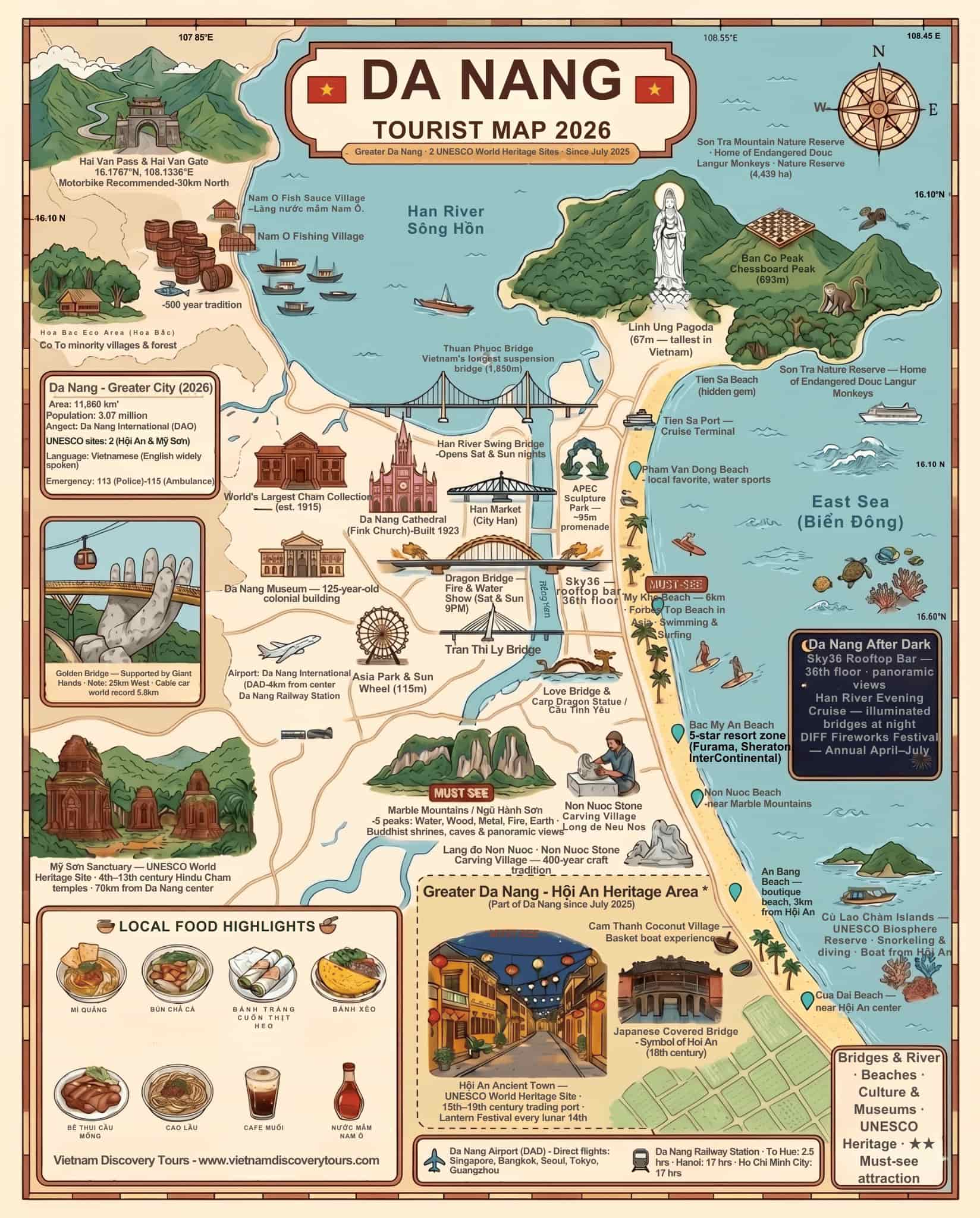
Linh Ung Pagoda is listed on every Da Nang tourist map. But most people arrive at the wrong hour, park in the wrong spot, and leave without seeing half the complex. This guide is what I tell every guest before we go — the things that make the difference between a tick on an itinerary and an experience they talk about for years.
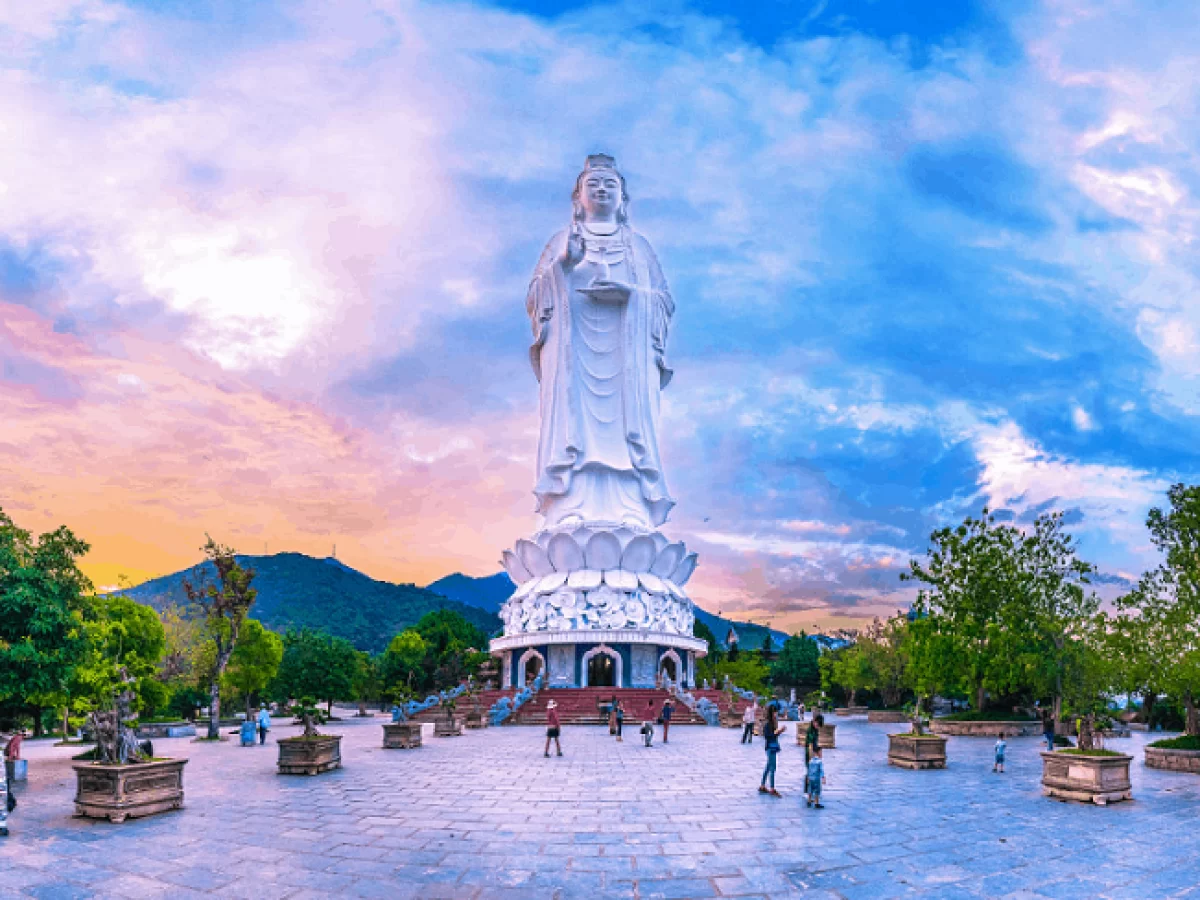
Lady Buddha at Linh Ung Pagoda — best photographed between 5:00–6:30 PM when the setting sun lights the statue from the west. The lotus base stands 35 metres in diameter. Free entry, open until 9 PM.
Original photo Linh Ung Pagoda on Son Tra Peninsula — home to Vietnam’s tallest Lady Buddha (67 m). The statue gazes seaward to protect fishermen, a tradition that began with a drifting Buddha statue in the 19th century.
67m
Lady Buddha height — tallest in Vietnam
20ha
Total pagoda complex area
639m
Altitude above sea level
357
Buddha statues inside the Lady Buddha
2004
Construction began
Free
Entry — always, forever
The Story Behind Linh Ung Pagoda
The name matters. Linh Ứng translates literally as miraculous response — a name earned, not given. During the reign of King Minh Mang of the Nguyen Dynasty, a wooden Buddha statue washed ashore at Bai But beach on Son Tra Peninsula. The fishermen who found it believed the sea had delivered a divine message. They built a small shrine to house the statue, and in the years that followed, the waters off Son Tra became notably calmer. The catch improved. Boats that once struggled in the swells of the East Sea came home safely.
The fishermen called the beach Bai But — Land of Buddha. The name stuck. The shrine expanded into a temple, the temple into a pagoda, and in 2004, ground was broken for what would become the largest religious complex in Da Nang. Six years later, in 2010, the Quan The Am Bodhisattva statue was consecrated. At 67 metres, she remains the tallest Lady Buddha in Vietnam.
Local perspective — what visitors rarely hear
The Lady Buddha faces east — directly out to sea. This is intentional. Local fishermen in Da Nang still believe she watches over boats leaving and returning through the waters visible from her feet. On the mornings I’ve arrived early enough, I’ve watched elderly men and women kneel facing the statue from the beach below, before sunrise, before the tourist coaches arrive. That ritual has nothing to do with tourism. It has been happening for generations.
The Lady Buddha — What’s Actually Inside
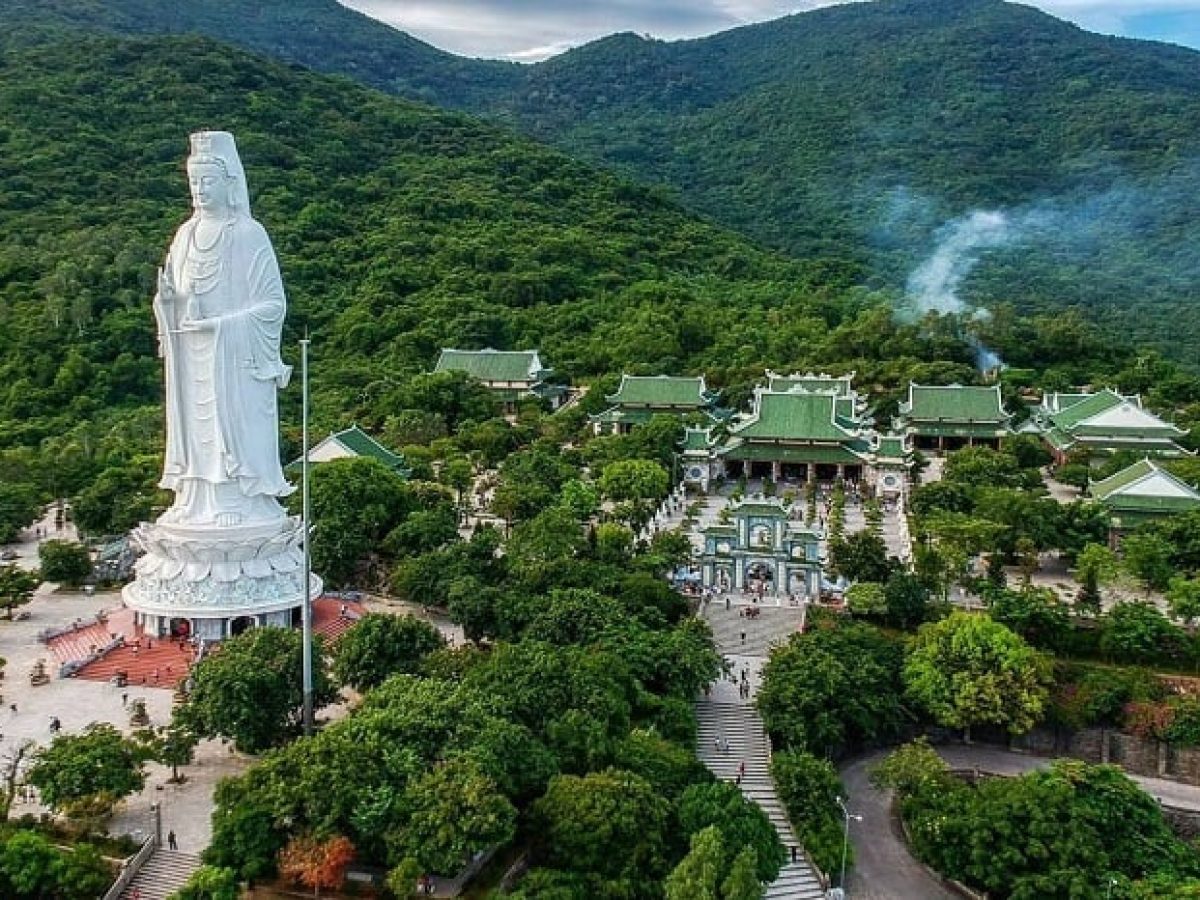
📷 Linh Ung Pagoda from above — the Lady Buddha stands at 639 metres altitude on Son Tra Peninsula, gazing east over Da Nang Bay toward Cu Lao Cham Island. The green-roofed temple complex and 20-hectare grounds are visible below.
The full 20-hectare Linh Ung complex from above — the courtyard alone covers 20,000 m² and houses 18 Arhat statues. Surrounded by 4,439 ha of protected forest.
Most visitors photograph the Lady Buddha from ground level and move on. Here is what the base contains — information I give every group before we approach:
The lotus base on which she stands is 35 metres in diameter. The base is hollow. Inside: 17 floors, each floor housing 21 Buddha statues — 357 statues in total. Each floor represents a different level of Buddhist enlightenment. The interior is open to visitors during certain ceremonial periods; on a regular visit, you can enter the ground level, where incense burns continuously and monks conduct prayers throughout the day.
The statue itself weighs thousands of tonnes and was engineered to withstand typhoon-force winds. Son Tra Peninsula takes a direct hit from tropical storms almost every October — the statue has stood through all of them without damage since its consecration in 2010.
Insider tip — the detail most guides miss
Look at the Lady Buddha’s left hand. She holds a small vase — the Purification Vase. In Buddhist iconography, this contains the water of compassion that cleanses suffering. Her right hand faces outward, palm open: the gesture of granting fearlessness and protection. Every element of the statue carries deliberate meaning. Most visitors see a large white figure. Knowing what she’s holding changes how you look at her.
The Architecture — What to See and in What Order
The Linh Ung complex from directly above — the Lady Buddha rises 67 metres above the pagoda grounds. Green-roofed buildings include the main hall (Chánh Điện), ancestral house, lecture hall and dining hall. The entire complex was built between 2004 and 2010.
The Main Gate — Start Here
The tam quan — triple-arched entrance gate — sets the tone. Three arches represent the Three Jewels of Buddhism: Buddha, Dharma (teaching), and Sangha (community). The green-glazed roof tiles are laid in the traditional Vietnamese style, curving upward at the eaves to symbolise ascent toward enlightenment. Carved dragons spiral around the columns — in Vietnamese Buddhist symbolism, dragons bring rain and prosperity, not fire and danger. Take your time at the gate. Look back through the arch at the stone staircase and the bay below; this is one of the finest compositional photographs in the complex.
The Main Hall — Chánh Điện
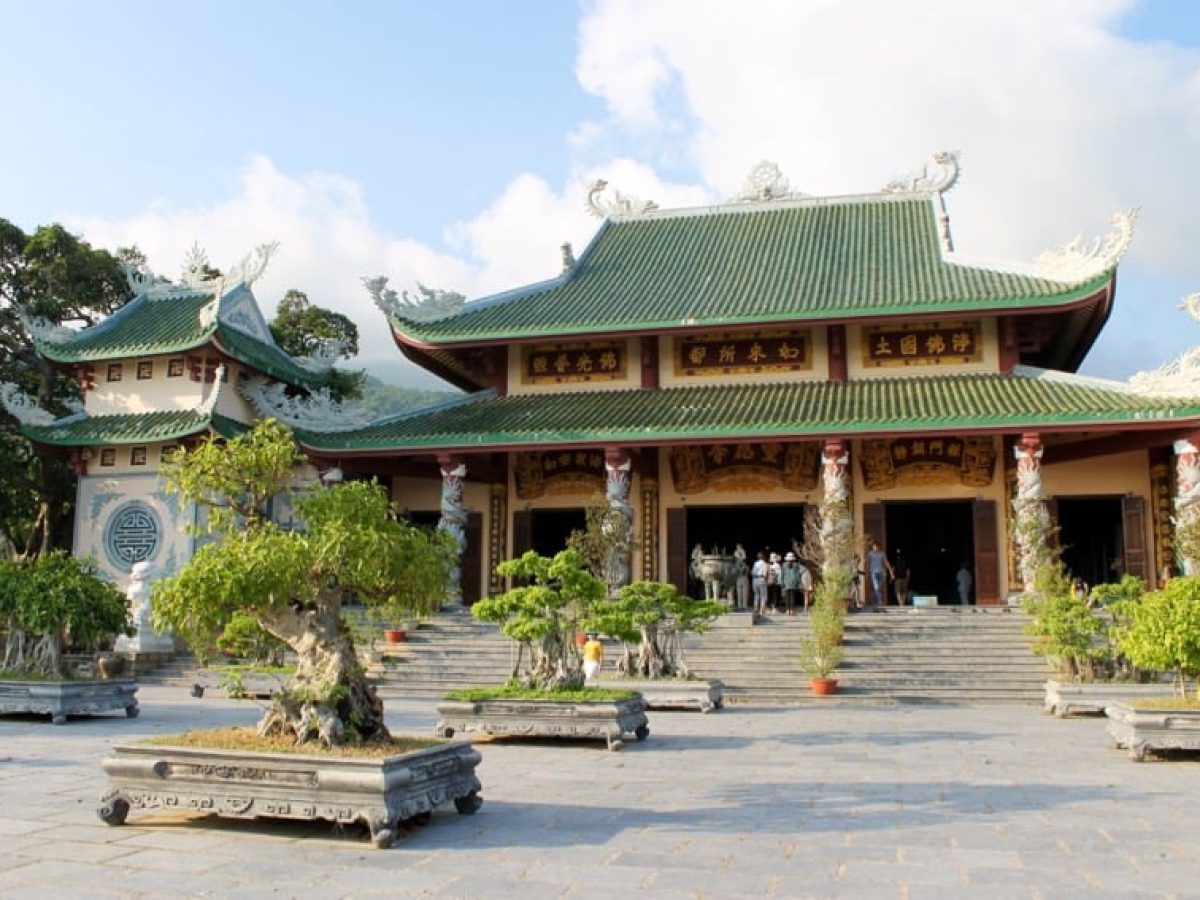
The Chánh Điện (main hall) at Linh Ung Pagoda — supported by 36 columns, topped with a three-tiered curved roof in traditional Vietnamese Buddhist style. Inside: Shakyamuni Buddha flanked by Quan The Am Bodhisattva. Remove shoes before entering.
Main worship hall — three-tiered curved roofing in classic Vietnamese Buddhist style. The bonsai collection in the courtyard is over 30 years old, some specimens brought from the original pagoda site.
The main hall is supported by 36 columns and topped with a three-tiered curved roof. Inside: Shakyamuni Buddha in the centre, flanked by Quan The Am Bodhisattva on the right and the Three Jewels Buddha on the left. Before entering, remove your shoes — there are shoe racks at the entrance. Move quietly and do not photograph worshippers praying without permission.
The 18 Arhat Statues
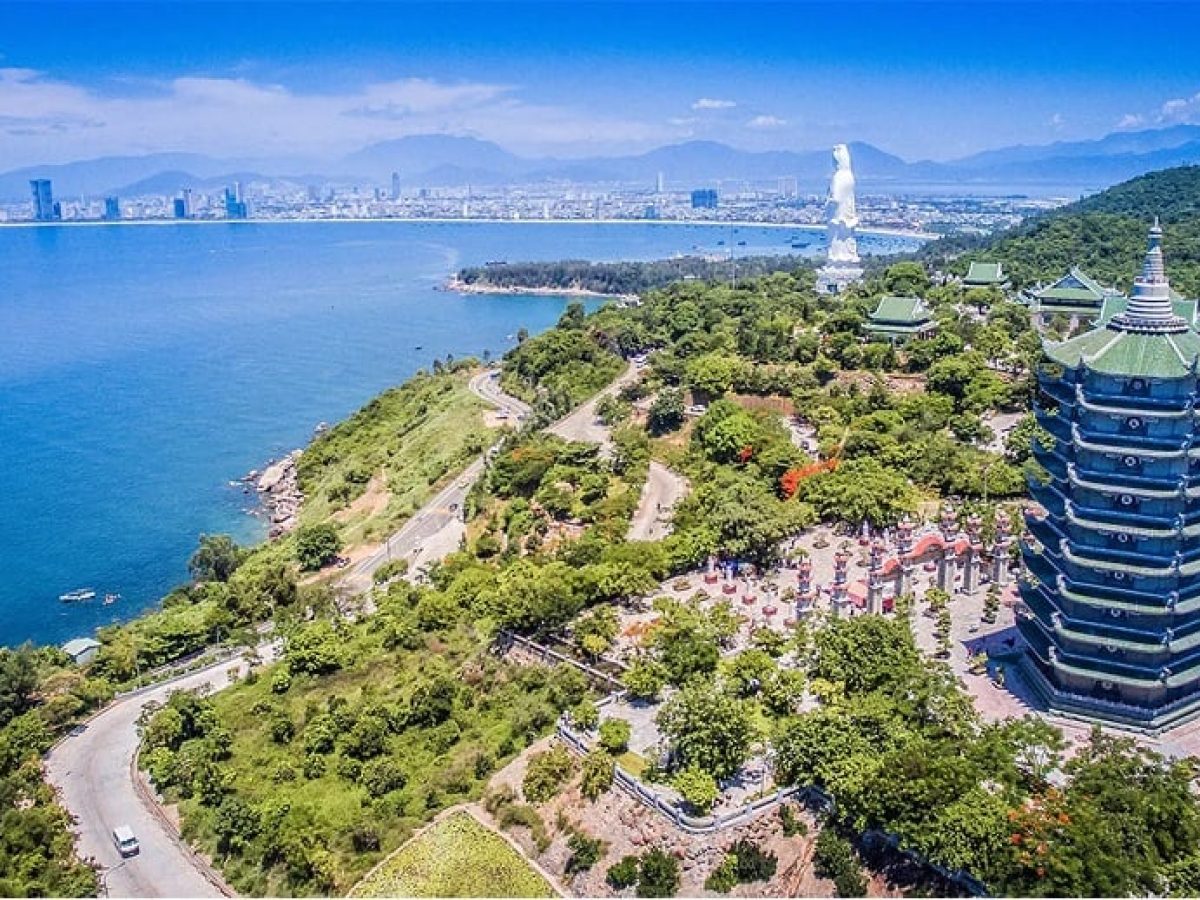
Son Tra Peninsula panorama — the winding road to Linh Ung Pagoda hugs the coastline for 10 km from Da Nang city centre. The multi-tiered tower on the right is part of the pagoda complex. Drive slowly: red-shanked douc langurs cross this road between 6–9 AM.
The 18 Arhat statues along the courtyard path — each represents a disciple who achieved enlightenment, depicted with a different human emotion: joy, sorrow, anger, contentment.
Lining the courtyard pathway, 18 white marble Arhat statues represent disciples of Buddha who achieved Nirvana and chose to remain on earth to guide others. Each statue depicts a distinct human emotion — look closely and you’ll find joy, grief, laughter, deep concentration. Locals believe touching the head of a specific Arhat brings relief from the emotion it represents. The statues are arranged in the sequence a practitioner moves through in pursuit of enlightenment.
Want to visit Linh Ung with a guide who knows its stories?
We combine Son Tra Peninsula, Marble Mountains and Da Nang’s bridges in one morning — the route I’ve perfected over 8 years.
Linh Ung Pagoda at Ngũ Hành Sơn (Marble Mountains)
Da Nang has three pagodas bearing the Linh Ung name. The one on Son Tra Peninsula is the most famous — but the version at the Marble Mountains (Ngũ Hành Sơn) deserves its own visit, not as an afterthought.
Three Linh Ung Pagodas — quick comparison
Son Tra Peninsula
The Famous One
67m Lady Buddha · 20ha complex · sea views · most visited
Near city centre · small · peaceful · rarely visited by tourists
The Ngu Hanh Son version sits on the Water Mountain (Thuy Son) inside the Marble Mountains complex. You reach it by elevator (10,000 VND) or on foot via 156 steps. The pagoda itself dates to the 17th century — far older than Son Tra — and its altar is carved directly into the cave wall. Entry to Ngu Hanh Son: 40,000 VND. Allow 2 hours for both the pagoda and Huyen Khong Cave.
Local tip — combine both in one day
8 AM: Son Tra Peninsula (Linh Ung Son Tra) — arrive early for the Lady Buddha in morning light. 45 minutes driving and 90 minutes at the pagoda. 11 AM: Marble Mountains (Linh Ung Ngu Hanh Son) — 25 km south, 35-minute drive. Combine with Huyen Khong Cave. Lunch at Non Nuoc Beach 5 minutes away. Two Linh Ung Pagodas, two completely different experiences, one morning.
How to Get to Linh Ung Pagoda from Da Nang
Linh Ung Pagoda is 10 km from the city centre. There is no direct public bus. Here are your real options — with honest advice on each:
Transport options — Da Nang city centre to Linh Ung Pagoda
Motorbike
Rent yourself — best option ★★★★★
20–25 min via Hoang Sa coastal road. Rental: 100,000–150,000 VND/day from most hotels. The coastal road past Son Tra Beach is one of Da Nang’s most scenic drives. Stop anywhere you want. Park at the pagoda gate: free.
Best value
Grab bike
Grab motorbike — convenient
25–30 min. Cost: 40,000–60,000 VND one way. Note: Grab drivers sometimes won’t go all the way up the mountain road — confirm destination before accepting.
40–60K VND
Grab car
4-seat Grab — comfortable
30–35 min. Cost: 80,000–120,000 VND one way. Best for families or groups. Ask driver to wait (extra fee ~20,000 VND/hour) or book return separately.
80–120K VND
Taxi
Metered taxi — most expensive
30–40 min. Cost: 150,000–200,000 VND one way. Use Mai Linh (0511 3565 656) or Vinasun. Avoid unmarked taxis near the beach hotels — overcharging is common.
Arrive before 7:30 AM — the mist makes the Lady Buddha appear to float
Morning sea mist on Son Tra Peninsula between March and August creates a phenomenon where the white statue appears to emerge from cloud. By 9 AM, the mist burns off and 15–20 tour buses arrive. The early morning experience and the midday experience are not the same place.
2
The monkey road starts 2 km before the pagoda — go slowly
Red-shanked douc langurs — one of Vietnam’s most endangered primates — live in the forested sections of the road. They come to the roadside between 6–9 AM. Drive at walking pace from the 8 km marker. Do not feed them (100,000 VND fine). Do not sound your horn. They will come to you.
3
The vegetarian restaurant inside the complex is the best lunch in Da Nang for 30,000 VND
Few tourists know the pagoda operates a vegetarian canteen on Buddhist feast days (1st and 15th of the lunar calendar) and on weekends. Set meal: 30,000–50,000 VND. The food is made by monks and volunteers using produce from the pagoda garden. It is extraordinary. Check the lunar calendar before you go.
4
Walk around the entire base of the Lady Buddha — not just the front
Most visitors photograph from the front forecourt and leave. Walk the full circle around the statue’s base. On the seaward side: an uninterrupted view of the East Sea, Cu Lao Cham Island on clear days, and the curve of My Khe Beach below. This viewpoint is on no tourist map. It takes four minutes to walk to and is worth 20 photographs.
!
Honest warning — what other sites don’t say
The road up Son Tra has several sharp curves. Motorbike accidents happen, especially with inexperienced riders on rented scooters. If you have never ridden a motorbike before, take a Grab car. The view from inside a car is 80% as good. The risk is 0%. Also: vendors near the parking area sell “lucky” items at inflated prices — you are under no obligation to buy anything.
Best Photo Spots — Only a Regular Visitor Finds These
01
Gate arch looking seaward
Stand inside the main gate, face south. The triple arch frames My Khe Beach and the blue horizon. Best: 7–8 AM with low golden light. Camera at chest height, wide angle.
02
Lady Buddha from the east side
Walk to the right of the statue base, past the garden wall. From here, the statue stands against open sky and the East Sea — no other structures. Best: any time but avoid midday harsh shadows.
03
Arhat pathway, low angle
Kneel at the start of the Arhat row and shoot along the line of statues toward the main hall. Bonsai trees frame both sides. Best: 8 AM, backlighting from the east.
04
Coastal road lookout, 4 km before pagoda
At the 6 km mark on the Son Tra road, a concrete pull-off on the left overlooks Da Nang Bay and the entire city. Sunrise from here is extraordinary. Almost no one stops.
What to Do Nearby — Half-Day Itinerary
Son Tra Peninsula half-day route — starting from Linh Ung Pagoda
6:30 AM
Linh Ung Pagoda
90 min. Arrive before mist lifts. Lady Buddha, main hall, Arhat garden, seaward viewpoint.
8:00 AM
Ban Co Peak viewpoint
693 m altitude. 15 min from pagoda. Best panorama of Da Nang Bay. Watch for douc langurs on the way up.
15 min
9:00 AM
Son Tra Beach breakfast
Secluded cove at the base of the peninsula. Banh mi stalls open from 7 AM. ~20,000 VND.
20 min
10:30 AM
My Khe Beach or Marble Mountains
Return to city: My Khe Beach 20 min south for swimming. Or continue to Marble Mountains (Ngu Hanh Son) 35 min for the second Linh Ung Pagoda.
20–35 min
Why This Place Is Different
Eight years of guiding in Da Nang, and I still feel something on the road up Son Tra at first light. Not religiosity — I’m not Buddhist — but something closer to scale. The mountain, the sea, the statue that the fishermen asked for and somehow got.
Da Nang has many things to see. Linh Ung Pagoda is the one I would keep if I could only keep one. Come early. Walk all the way around the base. Stay long enough for the silence to work on you.
Final moment — May 2025
A couple from Tokyo on their honeymoon joined my tour last month. Neither spoke much English. At the seaward viewpoint behind the Lady Buddha, they stood holding hands looking at the East Sea for a long time. On the way back down the mountain, the woman turned to me and said, simply: “Thank you for bringing us here and not to the other one.” I didn’t ask which other one she meant. I knew.
Frequently Asked Questions
What are the opening hours of Linh Ung Pagoda?
Linh Ung Pagoda on Son Tra Peninsula is open daily from 6:00 AM to 9:00 PM, including all public holidays. Entry is always free. Best time to visit: 6:00–8:30 AM before tour groups arrive and while morning mist still covers the peninsula.
How do I get to Linh Ung Pagoda from Da Nang city centre?
The pagoda is 10 km from Da Nang city centre. Best options: rented motorbike (20–25 min, ~100,000 VND/day), Grab motorbike (40,000–60,000 VND one way), or Grab car (80,000–120,000 VND). No public bus reaches the pagoda directly. GPS: 16.1030°N, 108.2780°E.
Is there a dress code at Linh Ung Pagoda Da Nang?
Yes. Shoulders and knees must be covered throughout the complex. Free sarongs are available to borrow at the entrance gate. Shoes must be removed before entering the main hall. There is no strict enforcement policy, but respectful dress is expected and appreciated.
How tall is the Lady Buddha statue at Linh Ung Pagoda?
The Quan The Am Bodhisattva (Lady Buddha) at Linh Ung Pagoda stands 67 meters tall — equivalent to a 30-storey building — making her the tallest Lady Buddha statue in Vietnam. The lotus base has a 35-metre diameter. Inside are 17 floors each containing 21 Buddha statues, totaling 357 statues within the structure.
What is the difference between the three Linh Ung Pagodas in Da Nang?
Da Nang has three Linh Ung Pagodas: (1) Son Tra Peninsula — the most famous, with the 67m Lady Buddha and 20-hectare complex; (2) Ngu Hanh Son (Marble Mountains) — a 17th-century pagoda inside the Water Mountain cave complex, admission 40,000 VND; (3) Bai But — the original small shrine near the city center. When people say “Linh Ung Pagoda Da Nang”, they almost always mean the Son Tra location.
Can I see monkeys at Linh Ung Pagoda?
Red-shanked douc langurs — one of Vietnam’s most endangered primates — live on Son Tra Peninsula and can often be spotted on the road to the pagoda, particularly in the forested section between the 6–8 km markers. Best time: 6–9 AM. Drive slowly, do not feed them (fines apply), and do not use your horn. They are completely wild and regularly come to the roadside.
Want to experience this with a local guide?
Visit Linh Ung Pagoda the Right Way
Early morning, monkeys on the road, the mist, the seaward viewpoint most visitors miss. We combine Son Tra Peninsula with the Marble Mountains in one unforgettable Da Nang morning.
Most popular
Da Nang Spiritual & Nature Morning
Duration: 5 hours Departure: 6:30 AM daily Max 8 guests Includes: Son Tra + Marble Mountains + local breakfast
“We arrived at Linh Ung before sunrise. The mist, the monkeys, the silence — our guide knew exactly where to stand and when. Nothing like any temple we had visited before. Book this tour.”
James & Yuki M.
Australia / Japan · Toured May 2025· Verified guest
Hi, I'm Simon. I live in Hanoi and have been guiding travellers across Northern, Central and Southern Vietnam since 2016. Having explored the country from top to bottom, I write these guides to share honest, on-the-ground tips – no tourist fluff.